My First Experience as a Coach in WRO 2026: Mechanical Challenges and Software Abstraction in Robo Missions
Introduction: The Paradigm Shift Towards Robo Missions
Participating in the World Robot Olympiad (WRO) 2026 represented a significant shift in the methodological approach of our preparation. Having previously attended the WRO 2024 edition in the Future Innovators category where the core of the project was primarily theoretical and conceptual validation, the transition to the Robo Missions (Junior) category introduced engineering challenges directly tied to physical execution and real-time automation.
The team consisted of two school-aged students facing the competitive standards of the WRO for the first time under my mentorship. The primary mission was to design, build, and program an autonomous robot capable of precisely executing the tasks stipulated on the official competition mat.
Construction Challenges: Overcoming Hardware and Time Constraints
The first major source of complexity was the temporal factor: the decision to participate materialized just 20 days before the regional competitions in Panama. Additionally, while my profile is heavily geared toward software development, mechatronics and building complex mechanical systems with modular snap-fit elements (LEGO) were fields where I possessed zero prior experience.
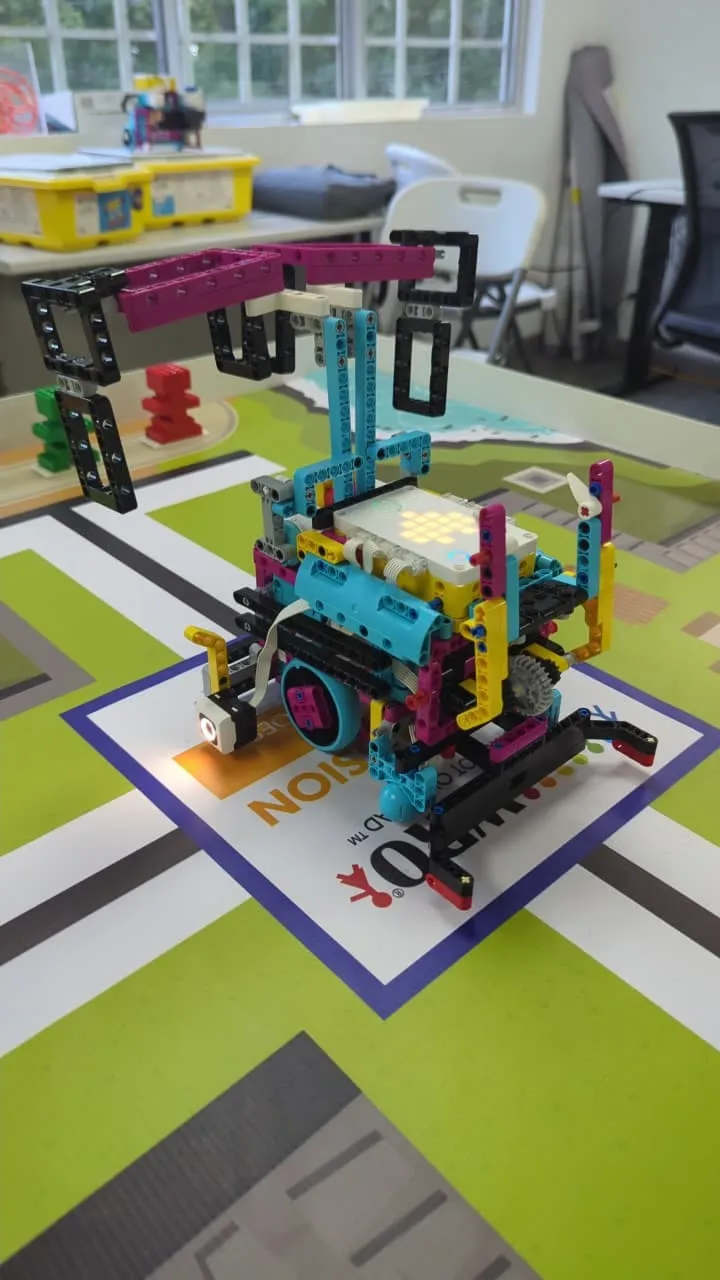
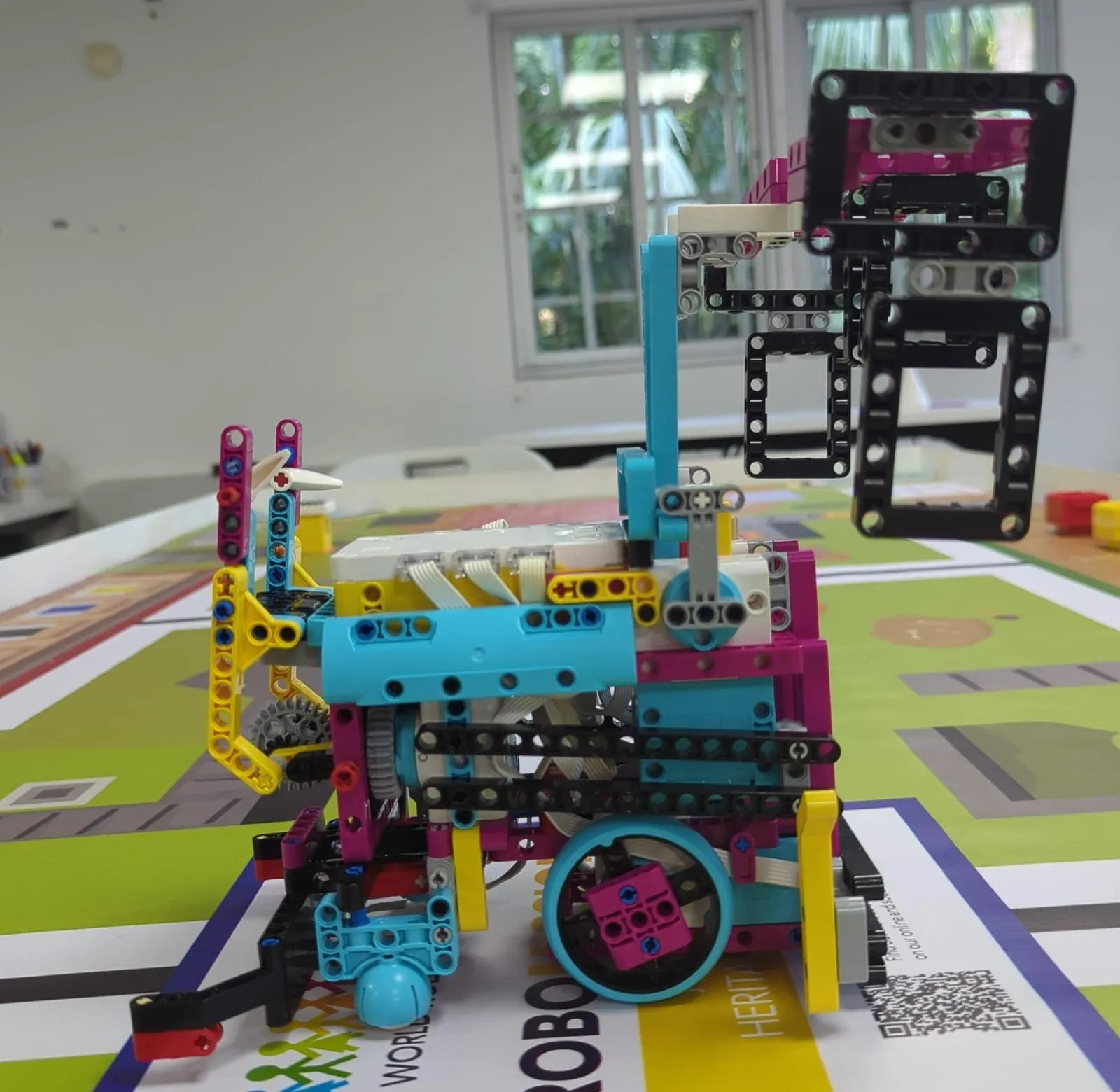
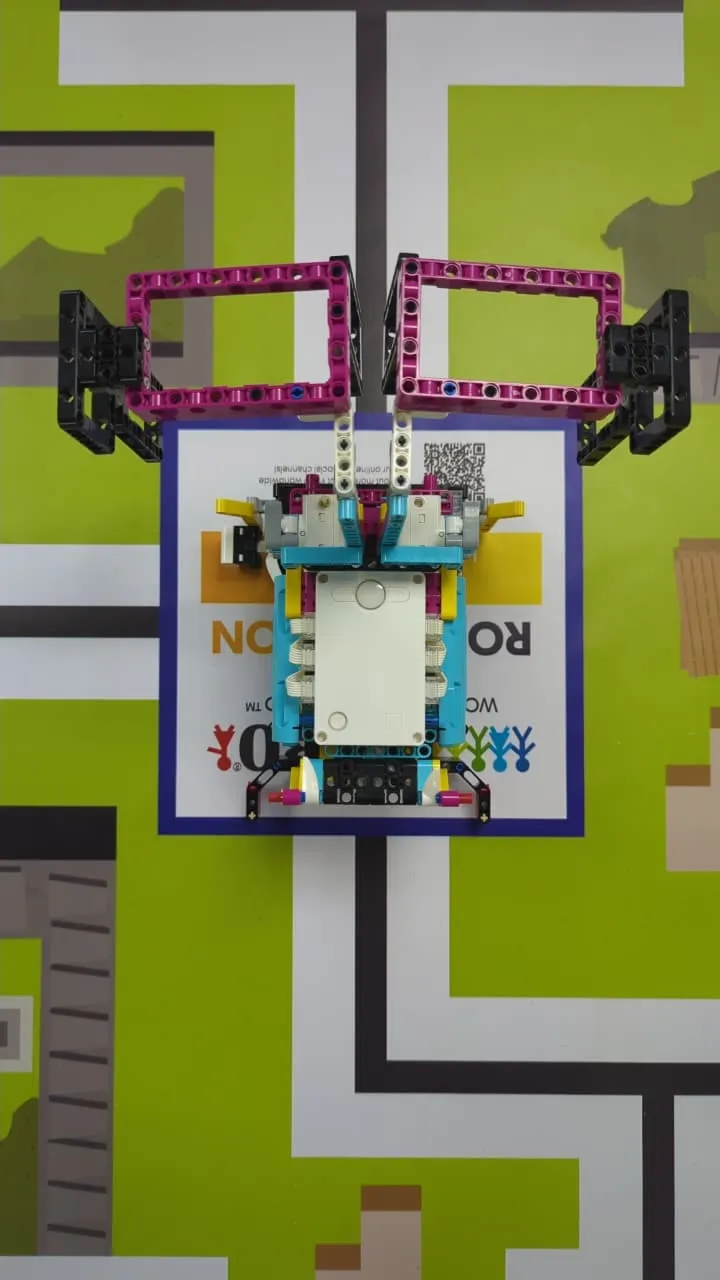
Despite these limitations, we successfully built a fully functional chassis using the LEGO Spike Prime v3 platform. The final design strictly complied with WRO regulations regarding maximum dimensions and weight restrictions. Below are the captures of the physical design of the robot from different perspectives, showcasing the distribution of the motors and mechanical actuators:
Designed Robot Gallery
- Side View:
- Another Side View:
- Top View:
Software Architecture: Custom Block Abstraction for Strategic Pivoting
To enable the students to program autonomously without losing millimeter precision on the mat, I implemented a software engineering approach based on functional abstraction. Instead of hardcoding raw and extensive sequences, I designed a set of custom blocks (base blocks) that encapsulated the mathematical and sensor logic of repetitive movements.
The developed base blocks included:
- Initialization and Configuration: Setting global variables and calibrating sensors.
- Locomotion: Controlled linear displacements (moving forward and backward) and kinematic calculations for rotations (turning left and right).
- Manipulation: Controlling secondary actuators (manipulating the arm and mechanical tails).
This software architecture mitigated mechanical calculation errors accumulated by friction or gear backlash, and provided the team with the capability to rapidly pivot strategy: if the order of the tasks on the mat required last-minute changes, the children could intuitively and safely rearrange the base block calls.
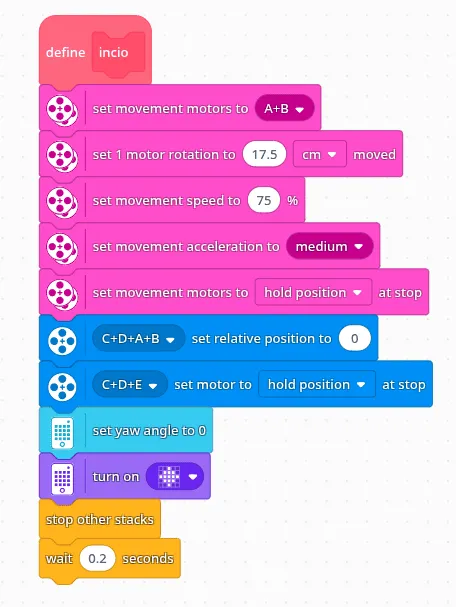
Initialization and Base Configuration Code
The initialization block establishes the velocity and synchronization parameters for the chassis motors:
Locomotion Control (Linear Movement and Turns)
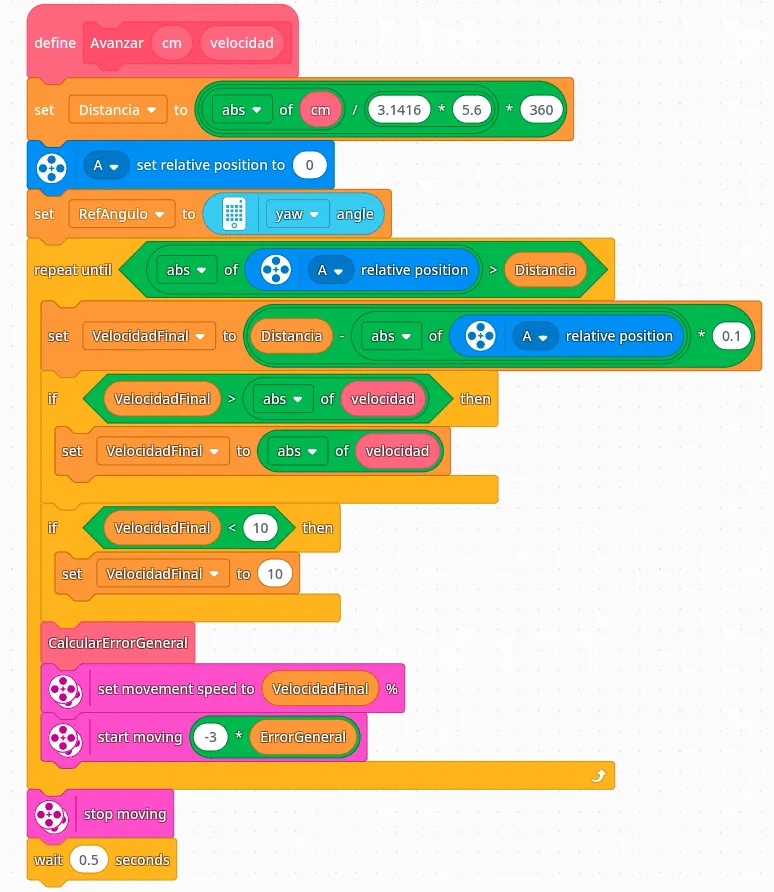
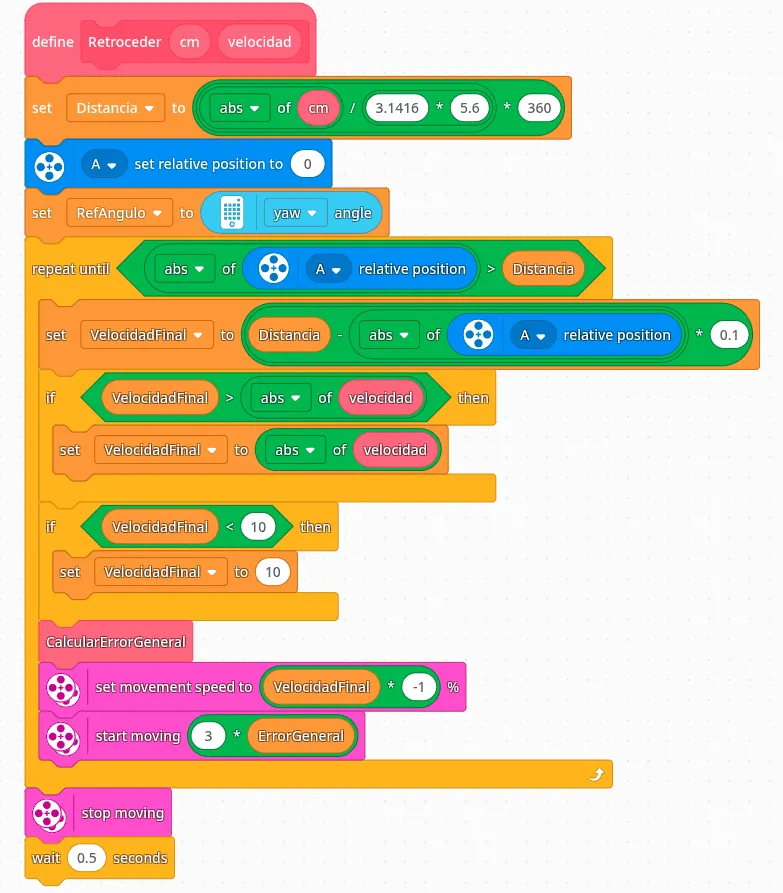
The linear movement algorithms ensure stable forward and backward displacements via software-defined power management:
- Move Forward:
- Move Backward:
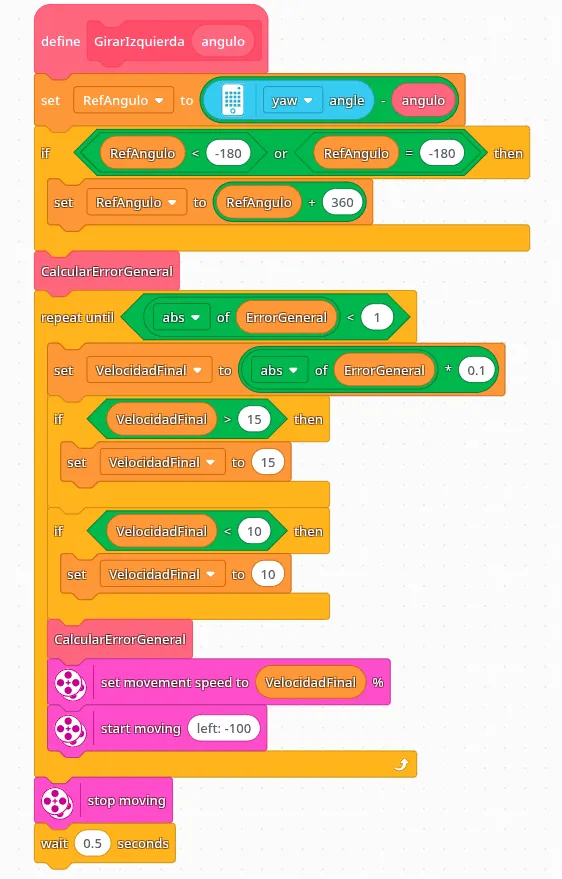
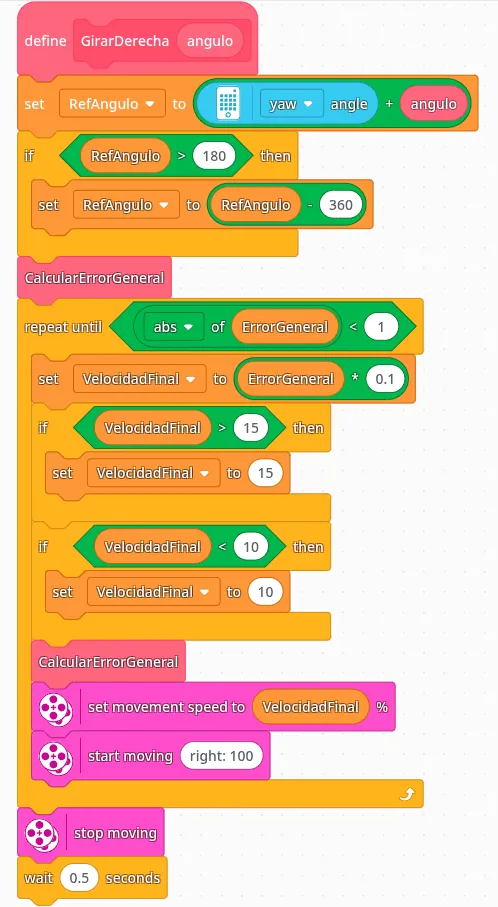
For orientation changes across the axes of the mat, closed-loop turn blocks were structured using motor degree counts or gyroscope readings:
- Turn Left:
- Turn Right:
Actuator Control (Mechanical Manipulators)
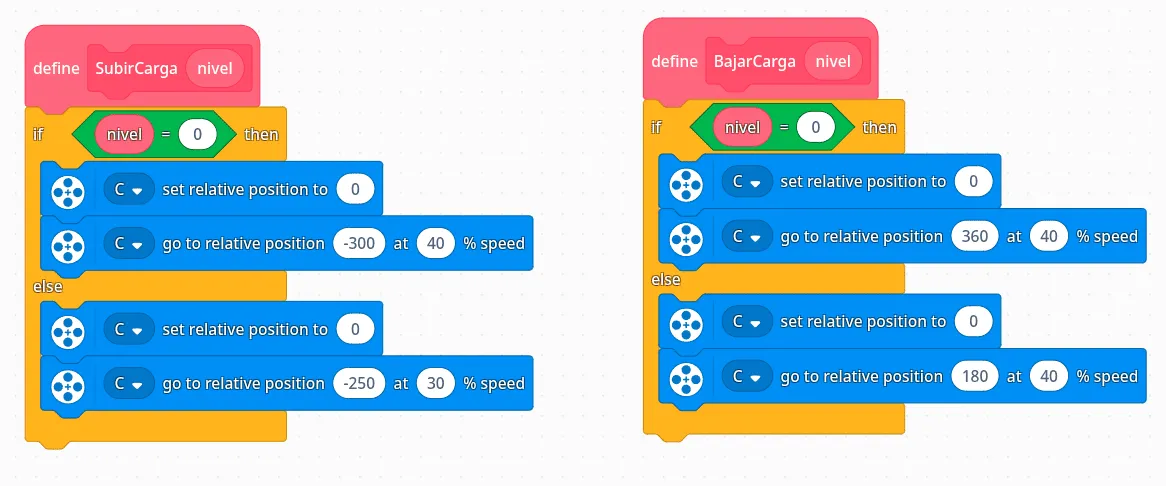
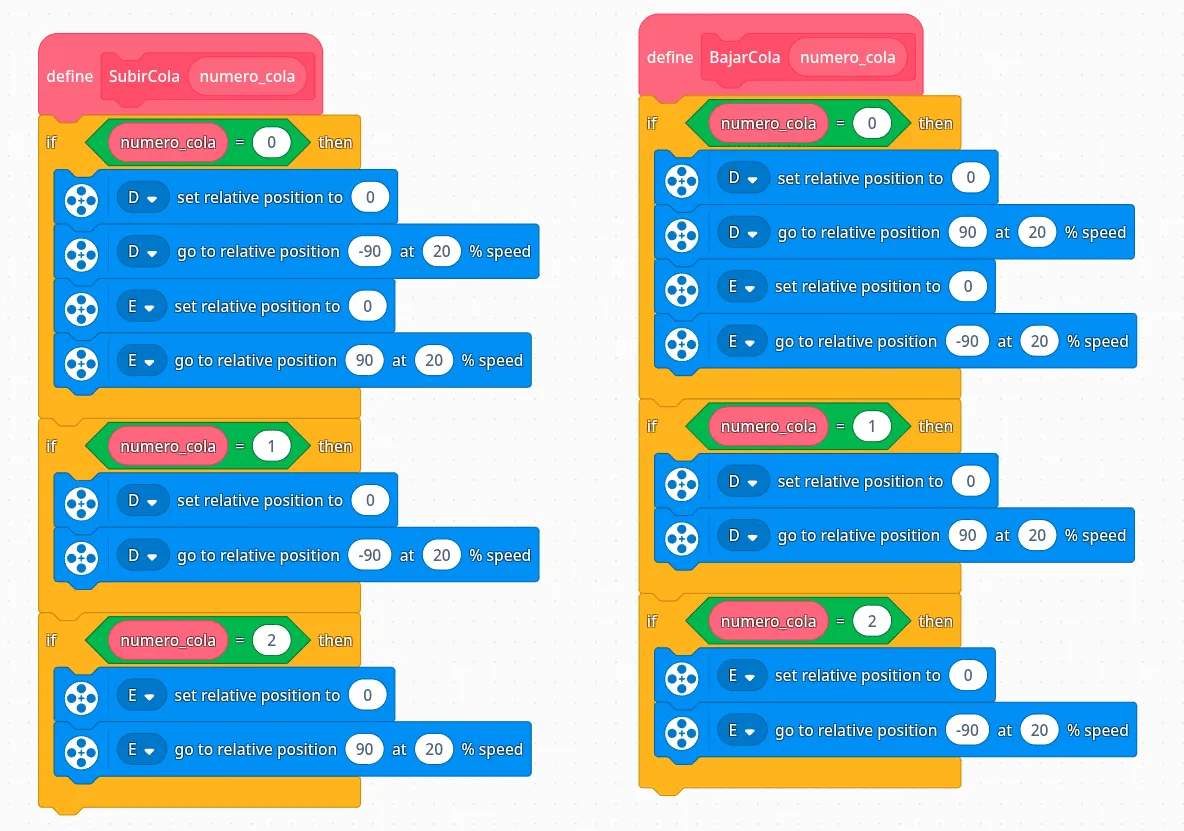
Interaction with game elements was managed through specific routines for the lifting arm and the stabilizing tails:
- Arm Control:
- Tails Control:
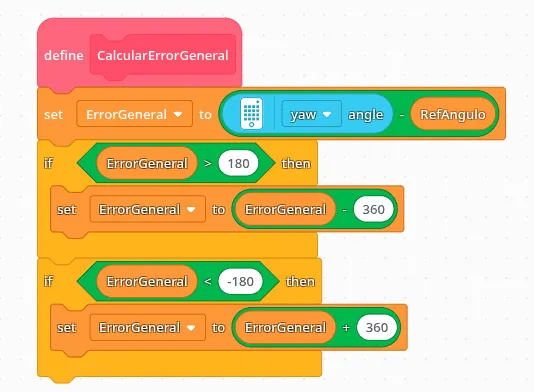
Mathematical Error Management and Calibration To resolve dynamic deviations on the mat, subroutines designed for real-time error calculation and compensation were integrated:
Conclusion and Future Outlook
Participating in WRO 2026 under these constraints demonstrated that implementing solid code abstraction practices can significantly compensate for a lack of experience in advanced mechanical manufacturing. The results obtained were highly satisfactory, achieving predictable and consistent autonomous behavior within the competition parameters.
This experience reinforces my affinity for pure software engineering, highlighting how abstract logic translates into physical and mechatronic control. The pedagogical impact on the students met the coaching objectives, introducing them to rigorous problem-solving methodologies within the STEAM framework. The process laid down the methodological foundations for structural and algorithmic optimizations in future robotics competitions.